Just Check the Camera, Dad
He was right. The footage existed. I told him it was inadmissible anyway.
Read the full essayIn part two of the childhood surveillance series, Ryan Vet's son tries to settle a sibling fight with security footage, and Ryan rules the video inadmissible.
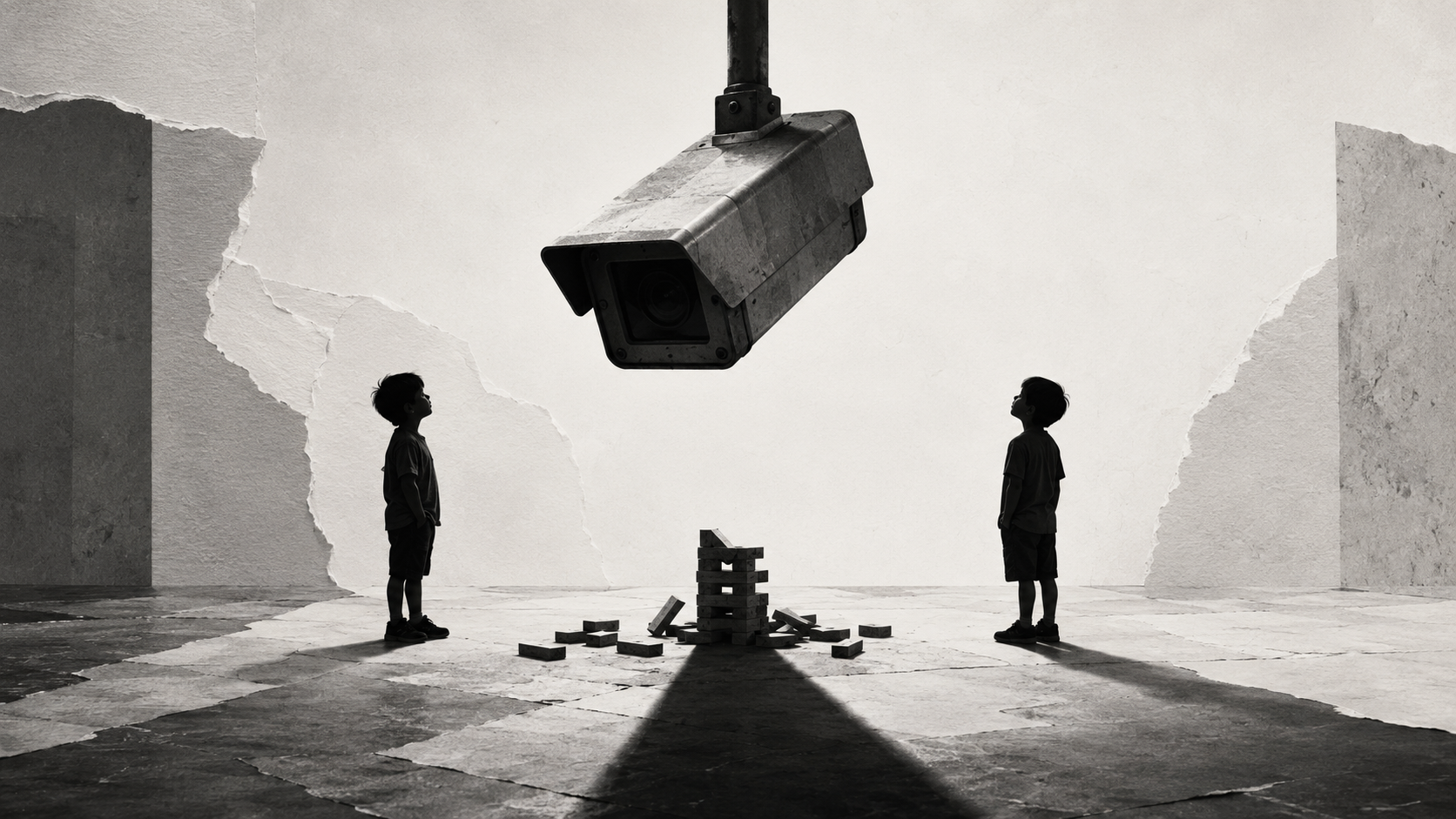
A knocked-over tower, two boys, and one request that stopped Ryan cold: pull up the camera and let the video decide who was guilty. The cameras existed, and the footage would have answered the question. Ryan refused anyway, because settling it with video skips the only part of the fight that teaches anything, the moment two kids have to decide together whether their word means anything.
From there he traces how ordinary the watching has become. About half of parents track their children's location on an ongoing basis (Burnell et al., 2023), Life360 reports roughly 95 million monthly users, and Owlet, maker of the baby oxygen-monitoring sock, cleared over 100 million dollars in revenue last year. He ties it back to Shoshana Zuboff's surveillance capitalism and to Tom LeNoble, Facebook's employee number 57, who watched the model get built from the inside. We resented being tracked, then turned around and did it to our kids.
The argument lands at work, which is where Ryan spends most of his time thinking. Teacher trust in students is the single strongest protector against burnout (Van Maele and Van Houtte, 2015), and Gallup puts the cost of low trust and engagement at roughly 10 trillion dollars a year. Ryan's own trust was earned rather than tracked: at 17 he flew nearly 7,000 miles to Beijing with no phone and no way to be found, because a lifetime of boundaries and freedom had already proven his word was good.
Trust cannot be bought, installed, or prompted into existence. It is earned slowly and destroyed in a split second, and it grows in exactly the friction that surveillance sands away.
Childhood surveillance is the norm, not a fringe habit. About half of parents digitally track their children's location on an ongoing basis (Burnell et al., 2023), with some consumer surveys reporting rates as high as 86 percent.
Watching does not calm the watcher. 25 percent of parents who track their children say it sometimes leaves them more anxious, not less (Clark et al., 2026).
Teacher trust in students is the single strongest protector against burnout, ahead of trust in colleagues or even the principal (Van Maele and Van Houtte, 2015). Trust is not a soft skill, it is load-bearing.
Gallup estimates low trust and engagement drain about 10 trillion dollars a year from the global economy. A generation raised to expect verification instead of trust is the generation about to inherit our companies.
Plain-language definitions for the ideas in this episode. Structured for search and AI answers.
The argument that the small difficulties we keep engineering out of life, working through a conflict, waiting, not knowing, are where character, resilience, and trust are actually built. Remove the friction and you remove the formation along with it.
In this episode: Why Ryan rules the camera footage inadmissible even though it would settle the argument outright.
Shoshana Zuboff's term for the practice of treating private human experience as free raw material for products the person being watched never sees (Zuboff, 2019).
In this episode: The model Ryan says we resented as consumers, then reproduced on our own children.
The finding that photographing an experience tends to make people remember it worse, not better (Henkel, 2014). The device that promises to hold the memory quietly keeps us from forming it.
In this episode: Ryan's closing point about what keeping the record actually costs.
Lines worth keeping, verbatim from the episode.
It takes a lifetime to earn trust, and a split second to destroy it.
I would trade a thousand correct answers for that.
We did not stop trusting our children. We just stopped needing to.
Protection can turn into overprotection.
Clips replayed from earlier conversations on the show. Each links to the full episode.
Straight answers to the questions this essay raises. Open by default, structured for search and AI.
What is the "Just Check the Camera, Dad" episode about? +
It is Ryan Vet reading part two of his five-part COLLIDE series on childhood surveillance. When one of his sons tried to settle a sibling argument by asking him to pull up the security footage, Ryan refused and called the video inadmissible. The episode argues that trust is load-bearing, and that every timestamp, location dot, and camera we add to a child's life removes the friction where trust is actually built.
Why wouldn't Ryan just check the camera? +
Because the footage answers the wrong question. It tells him who knocked over the tower, but it skips the moment his sons have to decide together whether their word means anything. Ryan's argument is that character is built in the not-knowing, so he would trade a thousand correct answers for the one conversation the camera makes unnecessary.
How many parents track their children's location? +
Peer-reviewed research finds that about half of parents digitally track their children's location on an ongoing basis (Burnell et al., 2023), and some consumer surveys report rates as high as 86 percent. The scale of the market matches: Life360 reports roughly 95 million monthly users, and Owlet cleared over 100 million dollars in revenue last year.
What does childhood surveillance have to do with the workplace? +
A generation trained to expect verification instead of trust will manage, hire, and work differently. Research finds teacher trust in students is the strongest single protector against burnout (Van Maele and Van Houtte, 2015), and Gallup estimates low trust and engagement cost the global economy about 10 trillion dollars a year. Gen Alpha is eligible to enter the workforce within about five years.
Full show notes
“Just check the camera, Dad.” When Ryan Vet’s young son tried to settle a sibling fight with security footage, it exposed how quietly surveillance has replaced trust in our homes, schools, and workplaces.
A knocked-over tower, two boys, and one request that stopped generational futurist Ryan Vet cold: pull up the camera and let the video decide who was guilty. In this episode of The Ryan Vet Show, USA TODAY bestselling author and international keynote speaker Ryan Vet argues that trust is load-bearing, and that every timestamp, location dot, and pulse oximeter we bolt onto a child’s life quietly removes the friction where trust is actually built. This is the second installment of a mini-series on proof, trust, and what shapes the next generation entering the future of work.
Key Takeaways
Trust cannot be bought, installed, or prompted into existence. It is earned slowly and destroyed in a split second, and it grows in exactly the friction we keep sanding away with surveillance.Childhood surveillance is now the norm, not a fringe habit. About half of parents digitally track their kids’ location on an ongoing basis (Burnell et al., 2023), with some consumer surveys reporting rates as high as 86%.The tracking economy is enormous. Life360 reports roughly 95 million monthly users, and Owlet, maker of the baby oxygen-monitoring sock, cleared over $100 million in revenue last year (Life360, 2026; Owlet, 2026).It started in the marketplace, not the nursery. Shoshana Zuboff called it surveillance capitalism: treating private human experience as free raw material (Zuboff, 2019). We resented being tracked, then turned around and did it to our kids.Watching does not calm the watcher. One in four parents who track their children say it sometimes leaves them more anxious, not less (Clark et al., 2026, C.S. Mott poll).This is a future-of-work problem. Teacher trust in students is the single strongest protector against burnout (Van Maele and Van Houtte, 2015), and Gallup estimates low trust and engagement drain about $10 trillion a year from the global economy (Gallup, 2026).Ryan’s own trust was earned, not tracked. At seventeen he flew nearly 7,000 miles to Beijing alone, with no phone and no way to be tracked, because a lifetime of boundaries and freedom had already proven his word was good.Research and Sources Cited
Burnell et al. (2023), parental digital location tracking, Journal of Family PsychologyClark et al. (2026), Safety or Surveillance, C.S. Mott Children’s Hospital National Poll on Children’s HealthZuboff (2019), The Age of Surveillance CapitalismHenkel (2014), photo-taking-impairment, Psychological ScienceVan Maele and Van Houtte (2015); Tsuyuguchi et al. (2025), teacher trust and burnoutGallup (2026), State of the Global WorkplaceU.S. Surgeon General (2024), Parents Under Pressure advisoryLife360 (2026) and Owlet (2026), full-year resultsRelated listening on The Ryan Vet Show: Tom LeNoble, Facebook employee number 57 (Ep 38), and Kevin Stinehart on rebuilding recess (Ep 31)Connect with Ryan Vet
Read the full Collide essay: https://ryanvet.com/collide/just-check-the-camera-dad/Subscribe to the Collide newsletter: https://ryanvet.com/collideLearn more and book Ryan to speak: https://ryanvet.comSend us Fan Mail
About Ryan VetRyan Vet is a USA TODAY bestselling author, futurist, and international keynote speaker whose insights on generations, culture, and the future of work have been featured in Forbes, Financial Times, ABC, NBC, and CBS. His research helps leaders understand emerging generational patterns and anticipate societal shifts before they fully unfold.
Join 20,000+ Leaders for Weekly InsightsIf you want deeper research and behind-the-scenes insights on generations and the future of culture and society, join Ryan’s weekly newsletter: 👉 https://ryanvet.com/collide