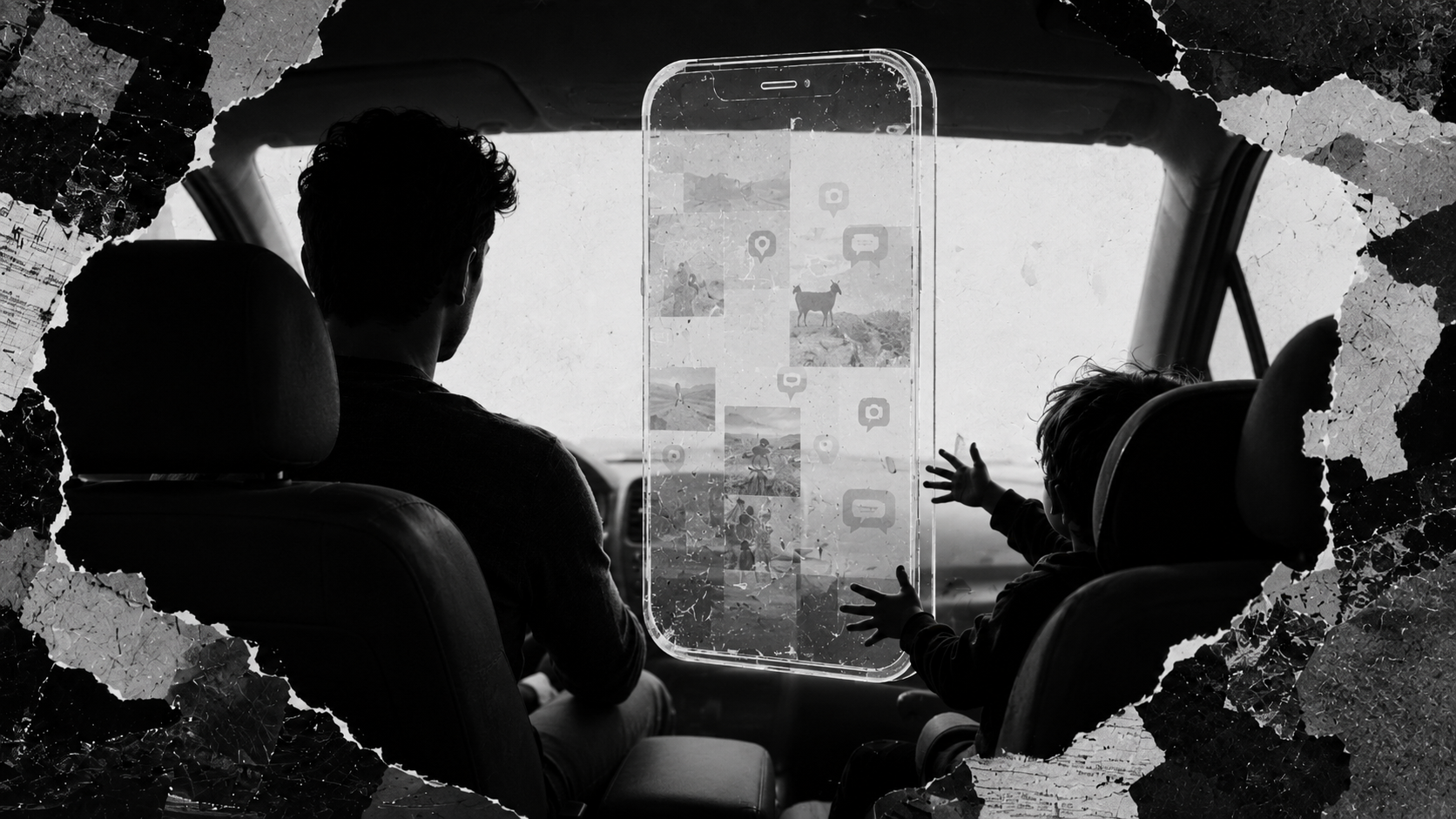
A parent lies awake at night and watches a small blue dot move across a map. The dot is their daughter, driving home from a friend's house, drawn in real time on a phone screen. Nothing is wrong. The dot is exactly where it is supposed to be. And still the parent watches, because at some point the watching became its own kind of comfort.
I want to be careful with the term I am using, because it already means something else. In pediatrics, "childhood surveillance" refers to developmental surveillance, the ordinary and good practice of a doctor tracking a child's milestones over time. That is not my subject. I am writing about the cultural and technological version of the phrase, the one rising quietly in our searches and our anxieties: the steady, layered watching of children as they grow, and what a childhood spent under observation does to the person it produces.
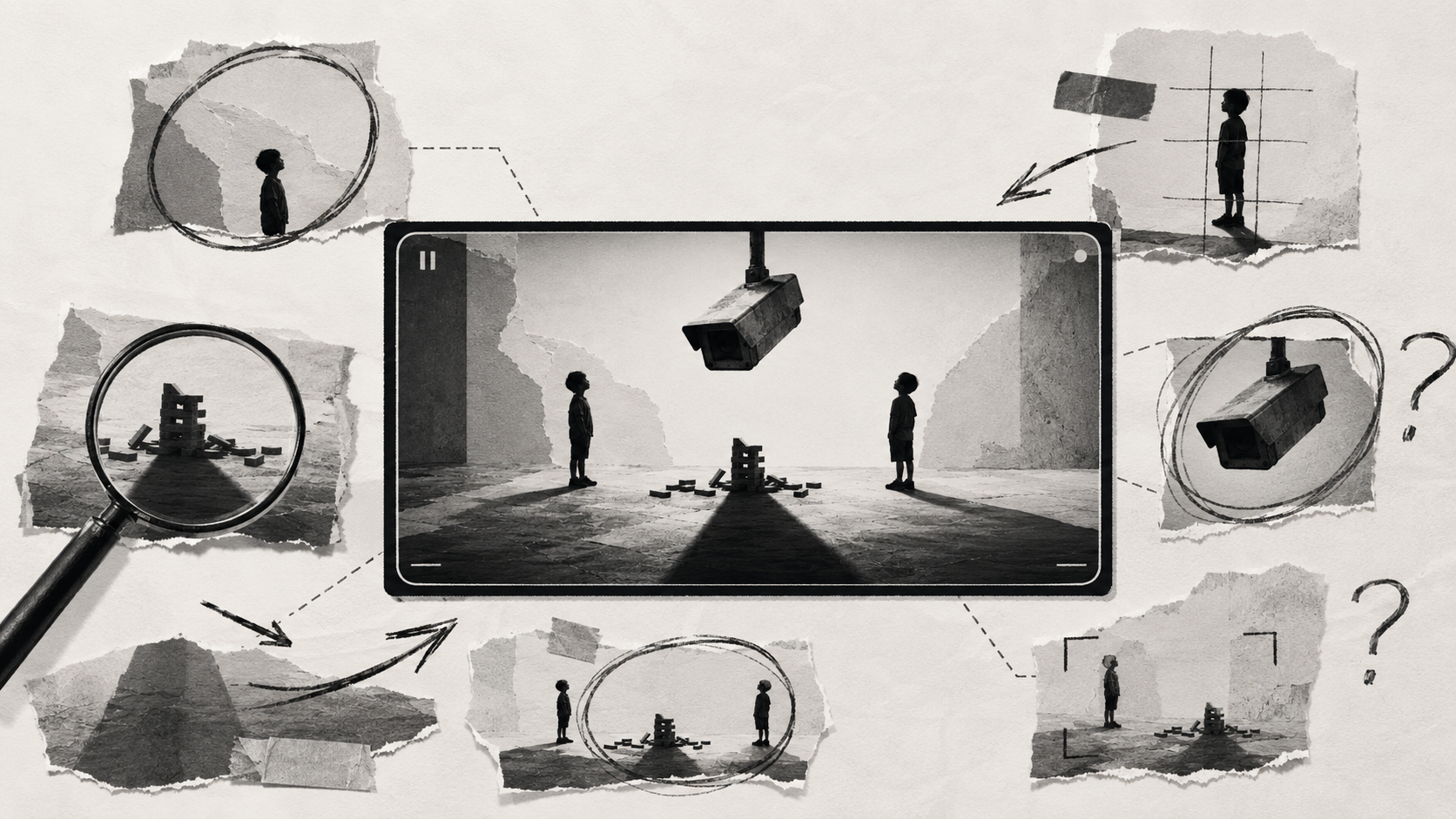
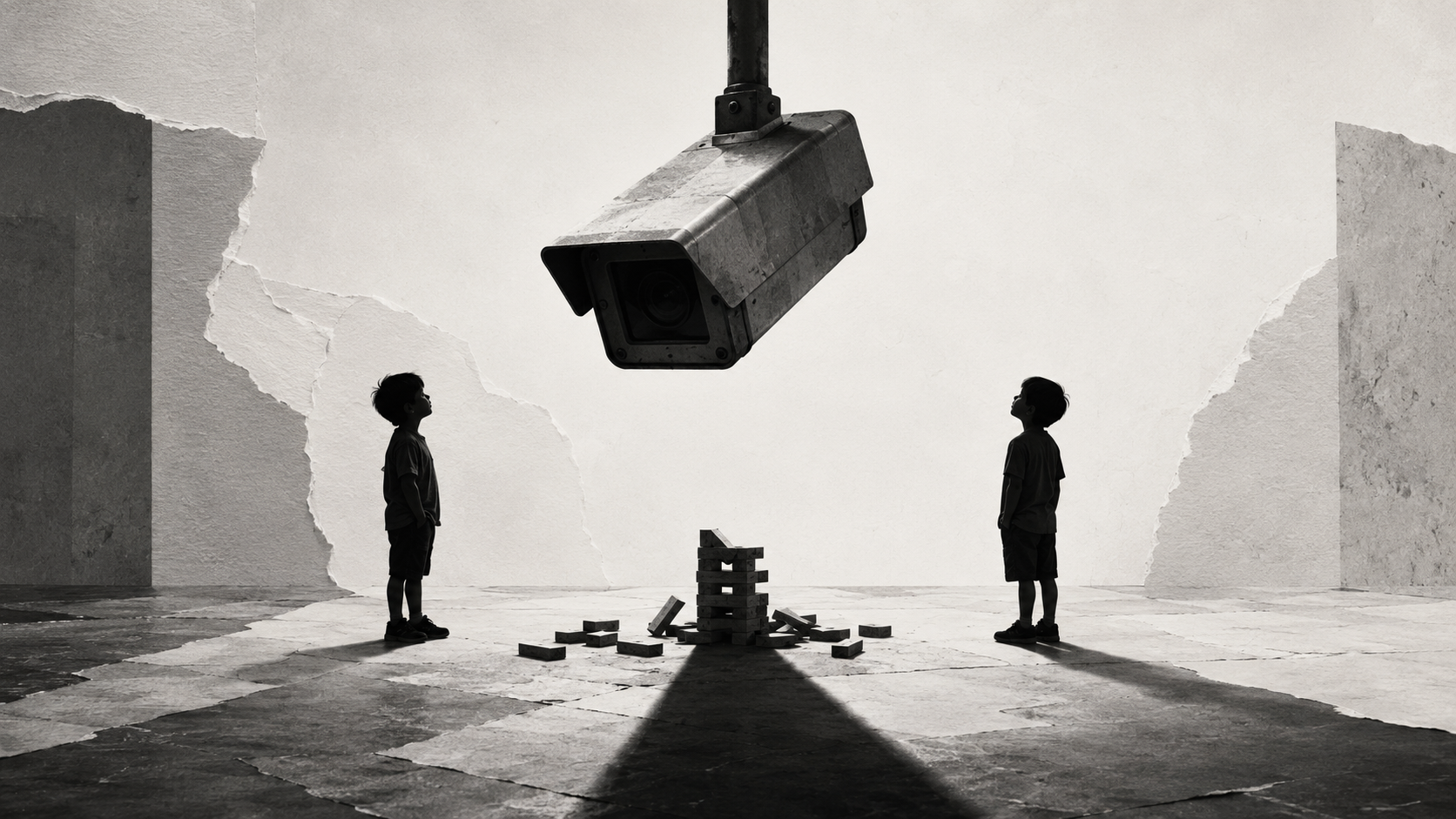
This is not really a story about one app or one worried parent. It is a story about a condition. Some people call it surveillance childhood. The words can be swapped and the meaning holds. What matters is that we have, without ever deciding to, built the first childhood in human history with no reliable expectation of being unobserved.
It didn't start with the smartphone
The instinct to watch our children is older than any device. The first commercial baby monitor, Zenith's Radio Nurse, arrived in 1937, designed in the shadow of the Lindbergh kidnapping. It let a parent in one room hear an infant in another. It was a small miracle, and it was also the first thread in a net we have been weaving ever since.
The threads accumulated slowly, then all at once. Nanny cams in the 1990s. GPS in the 2000s. Then the smartphone put a tracker in every pocket, and a generation of parents discovered they could see, at any moment, exactly where their child was standing. Location apps turned that ability into a habit. School platforms extended the watching into the classroom, logging behavior, flagging keystrokes, scanning student email for risk. And long before a child is old enough to object, their life is already posted, tagged, and archived by the people who love them most. The American Psychological Association devoted much of its 2026 guidance to sharenting, the ordinary act of documenting a child's life online, and to the digital footprint a person now inherits at birth rather than builds by choice.
Every one of these layers was added for a reason a good parent would recognize. Safety. Reassurance. The unbearable arithmetic of loving someone in a frightening world. And the fear underneath it, though it feels rational from the inside, runs wildly ahead of the risk. A child's odds of being abducted by a stranger in a given year are roughly one in three million (Zgoba). The net was built less on danger than on headlines and moral panic. None of it feels like surveillance from the inside. That is exactly why it works.
What we take when we watch
Here is the part we rarely say out loud. A childhood needs a backstage.
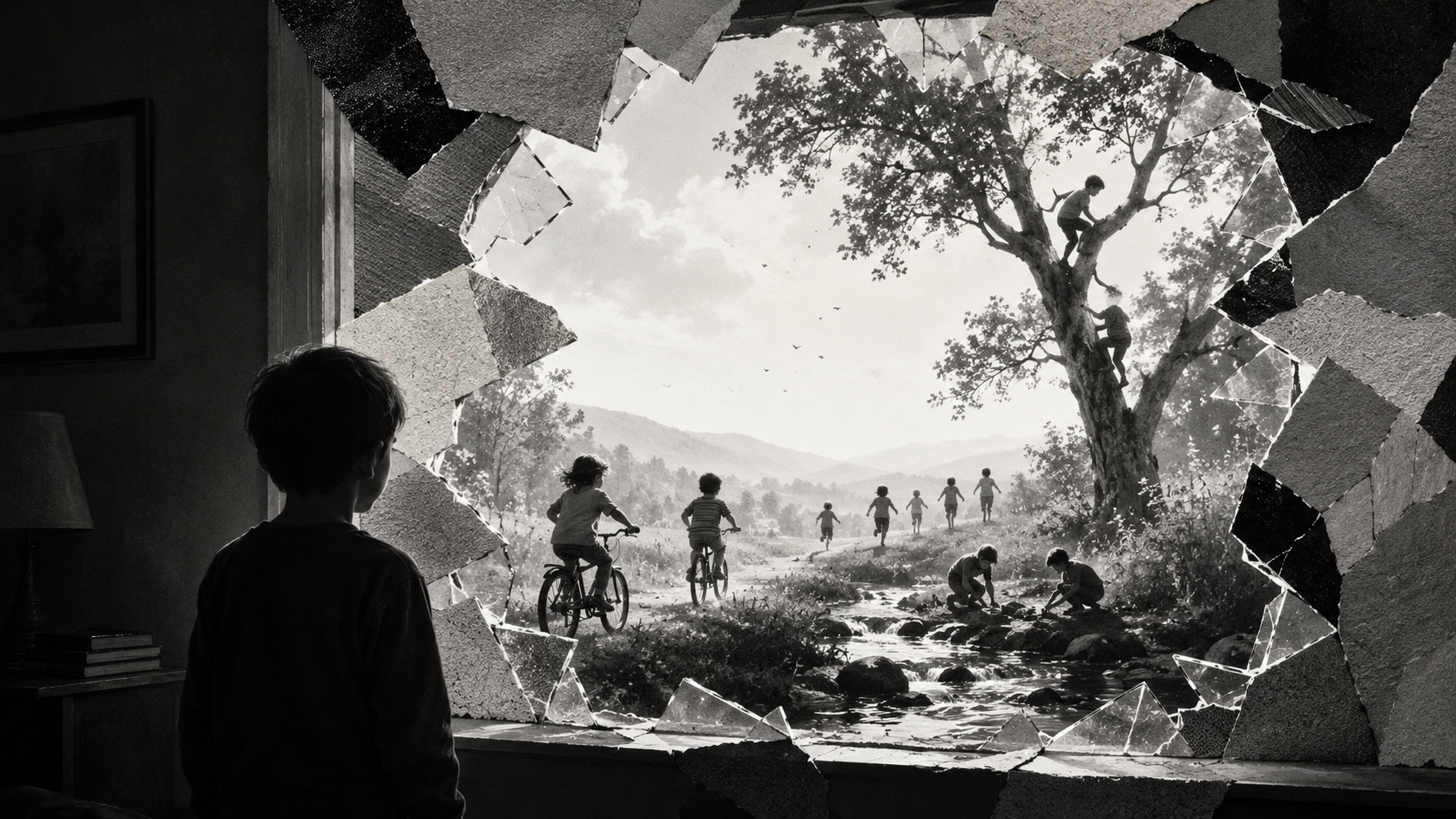
Children become people in the spaces where no one is looking. The walk home taken alone. The argument settled on the playground before an adult could intervene. The small, secret, unsupervised hour in which a child tries on a version of themselves and finds out whether it holds. That unobserved space is not a gap in a childhood. It is where the formation happens.
Take it away, and you do not remove the risk. You remove the rehearsal. Developmental researchers who study the late teens and early twenties keep returning to the same point, that young people need parts of their lives their parents are not in on in order to build independence and a durable sense of self. When the watching never stops, a child never gets to practice being a person without an audience. They learn, instead, to perform for one.
This is the quiet engine behind what I have elsewhere called the rise of fragility. A baby learns to walk by falling hundreds of times. When we pad every fall and pre-remove every obstacle, we do not protect the child, we interrupt the loop that produces confidence. Surveillance is not the only way we do this, but it may be the most invisible, because it removes nothing a child can see. It simply makes sure someone is always watching the fall.
Monitoring, surveillance parenting, and the condition underneath
To see this clearly, it helps to separate three words we tend to blur together.
The first is parental monitoring. This is the clinical, academic term, and it deserves respect. Dishion and McMahon defined it in 1998 as the structured attention a parent pays to a child's whereabouts and company, and decades of research have linked it to lower rates of risky behavior. But the construct has a twist worth knowing. In 2000, Stattin and Kerr reexamined the evidence and found that much of what looked like the fruit of parental tracking actually came from something else entirely: the child's own willingness to disclose. What protected kids was not surveillance. It was trust, and a relationship in which a child chose to tell.
The second word is surveillance parenting. This is the journalistic framing, vivid and useful and a little reactive. It describes a style, a way some parents parent, and it invites us to ask whether we are doing it too much.
The third is the one I am after. Childhood Surveillance is neither the construct nor the style. It is the condition underneath both, the environment itself. Parental monitoring is what an individual parent does. Surveillance parenting is what we call the choice. Childhood surveillance is the world the child actually grows up inside, whether or not any single parent chooses it, because the schools and the platforms and the culture have already made watching the default. Cognitive Erosion works the same way: offloading one task is a choice, but the erosion is the cumulative result no one chose. Here, a single tracking app is a choice. The surveilled childhood is the result.
The first generation with no unwatched hours
This lands hardest on the youngest among us. Gen Alpha is being raised inside the net. Gen Beta, just beginning to arrive, will be born fully inside it, with no before to remember. They are, in the truest sense, the watched generation, the first cohort for whom being seen is not an event but a baseline.
There is a generational irony worth naming. Gen Z, the first cohort to grow up online, learned that being seen can feel safer than being unseen. Now grown, many of them are the parents installing the cameras. A childhood that is parent tracked and algorithm raised is the world they are building for the children who come after them, not out of carelessness, but out of the same instinct to keep the ones they love inside the frame.
This is where Childhood Surveillance meets the Friction Doctrine, the idea that difficulty, waiting, and unsupervised struggle are not obstacles to formation but the mechanism of it. The unobserved hour is a kind of friction. It is uncomfortable for the parent and formative for the child. Remove it, and you have removed one of the last places a young person learns to trust their own judgment before anyone checks their work.
The evidence that this comes at a cost is no longer speculative. The Nuffield Foundation, in its 2025 feature "The Monitored Generation," found that roughly half of parents and adolescents now report using location tracking, and that among older teens who experience the tracking as intrusive, it correlates with more of the very problems it was meant to prevent. As one young person put it, a parental control app might make a parent feel safer, but it can really mess with trust. And the watching no longer stops at eighteen. In June 2026, NPR reported on a University of Michigan survey finding that a majority of parents track the location of their children aged eighteen to twenty-five. The developmental psychologist Laurence Steinberg, quoted in that coverage, noted that the late teens and early twenties are a critical window for building autonomy, and that constant tracking without genuine consent is, in his words, probably a bad idea. The childhood condition is becoming an adulthood one.
What this asks of parents and leaders
I want to be fair here, because the honest answer is a trade-off, not a villain. Monitoring genuinely protects children. The research is real, the reduced-risk findings are real, and any parent who has felt the flood of relief when a dot finally starts moving toward home knows the pull is not irrational. Lenore Skenazy, whose Free-Range Kids work and Let Grow movement I discussed with her on The Ryan Vet Show, does not argue that danger is imaginary. She argues that we have badly miscalibrated the ratio, trading enormous amounts of childhood autonomy for small and often illusory gains in safety.
When we spoke, she named the deeper cost better than I could. "We're replacing faith with certainty," she told me, "and certainty is more tenuous, because you have to keep checking it." That single sentence holds the whole problem. Independence, in her framing, is how a child builds an internal locus of control, the felt sense that they can handle things. Surveillance offers certainty in its place, and certainty is not a feeling you arrive at. It is a thing you have to refresh, every hour, for the rest of your life.
So the question is not whether to watch. It is which watching is worth keeping. The same discipline the Friction Doctrine asks of us elsewhere applies here. Not the removal of all friction, but the deliberate choice of which friction forms us. A location shared by mutual agreement is different from a location extracted without consent. A conversation is different from a scan. A child who tells you where they are because they trust you is safer, by the actual evidence, than a child who is tracked because they cannot be trusted. Freedom without trust isn't freedom. It's probation.
We are early in this conversation. The searches are only now beginning to rise, the studies are only now catching up to the habit, and most of us have never once stopped to ask what a fully observed childhood produces on the far side of eighteen. That is the question worth sitting with. We taught a generation that to be safe is to be seen. We have not yet asked them what it costs to never once be unseen.
The five-part series on Childhood Surveillance
Ryan Vet traced this framework across five consecutive Collide essays, running from the small moment that started it to what a fully watched childhood produces. Read in order:
- Did You Get the Photo of the Goat? Part 1 How a live-feed childhood quietly reprogrammed the question "how was your day?"
- Just Check the Camera, Dad Part 2 The moment a child reaches for the footage instead of his brother’s word.
- Same Footage, Two Verdicts Part 3 Why more proof is making us trust each other less, not more.
- Anyone Can Clone Your Voice Part 4 What happens to trust when the proof itself can be faked in seconds.
- Gen Alpha Is the Experiment Part 5 What a fully watched childhood produces, and what to actually do about it.
Frequently asked questions about childhood surveillance
What is childhood surveillance?
Childhood surveillance is the continuous monitoring, tracking, and recording of children, by parents, schools, apps, cameras, and algorithms, as a normal condition of growing up. Each layer tends to be added for safety, but the cumulative effect is a generation coming of age with little expectation of unobserved space. It names the environment a child grows up inside, not any single parenting decision.
Is childhood surveillance the same as developmental surveillance?
No. In pediatrics, "developmental surveillance" is a doctor’s ongoing tracking of a child’s growth and milestones, and it is a normal, valuable part of healthcare. Childhood surveillance, in the cultural sense used here, means something different: the technological and social watching of children through tracking apps, cameras, school platforms, and online documentation. They share a phrase but not a subject.
What is the difference between parental monitoring and surveillance?
Parental monitoring is the academic term for a parent’s structured attention to a child’s whereabouts and company, and research links it to lower risk behavior. Notably, later research by Stattin and Kerr found that much of its benefit comes from a child’s voluntary disclosure rather than from tracking itself. Surveillance is what monitoring becomes when the watching is continuous, automated, and no longer depends on the child’s consent or the relationship.
Is it healthy to track your child’s location or phone?
It depends far less on the technology than on how it is used. Location sharing by mutual agreement, in a relationship of trust, looks very different from covert or constant tracking, which research associates with reduced trust and, among older teens, more of the problems it was meant to prevent. The developmental evidence is clear that children and young adults need some unobserved space to build autonomy, so the healthiest approach treats tracking as a conversation, not a default.
What does growing up under constant surveillance do to kids?
The central concern is not any single harm but a cumulative one: children become people in unobserved space, and constant watching removes the rehearsal where autonomy, judgment, and a private self are formed. Studies link intrusive tracking to eroded trust between parent and child, and developmental researchers warn that young people denied private parts of their lives struggle to build independence. The effect is quiet and long, which is precisely what makes it easy to miss.
- Dishion, T. J., & McMahon, R. J. (1998). Parental monitoring and the prevention of child and adolescent problem behavior: A conceptual and empirical formulation. Clinical Child and Family Psychology Review, 1(1), 61–75.
- Stattin, H., & Kerr, M. (2000). Parental monitoring: A reinterpretation. Child Development, 71(4), 1072–1085.
- Nuffield Foundation. (2025). The Monitored Generation: Navigating Autonomy and Independence in the Digital Age.
- Aubrey, A. (2026, June 15). Most parents track their 18- to 25-year-old kids on their smartphones. Is it healthy? NPR, reporting on the University of Michigan C.S. Mott Children's Hospital National Poll on Children's Health.
- Skenazy, L. Free-Range Kids and Let Grow. Interviewed on The Ryan Vet Show (quote verbatim from that conversation).
- American Psychological Association (2026). Guidance on sharenting and the digital footprint children inherit at birth.