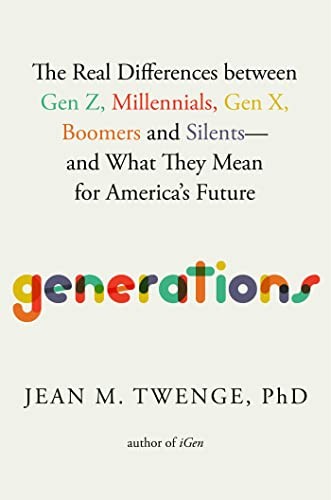
Generations
The Real Differences Between Gen Z, Millennials, Gen X, Boomers, and Silents and What They Mean for America's Future
Generations by Jean M. Twenge (2023) — Jean Twenge uses age-period-cohort analysis on decades of survey data to argue that technology, not events, is what actually separates the generations.
Reviewed by Ryan Vet · Last updated
What is Generations about?
Psychologist Jean Twenge analyzes survey data covering roughly 39 million Americans to compare six generational cohorts across attitudes, behaviors, and life outcomes. She argues that technology, more than events or economics, is the underlying driver of generational change, and traces implications for work, family, politics, and mental health.
Is Generations worth reading?
The most useful reference book on my shelf for this work, and the one I treat most carefully. Read it for the method, because separating age effects from period effects from cohort effects is the thing almost every generational take gets wrong. Verify any specific figure before you put it on a slide.
Read it if…
- You quote generational statistics in public and want to stop being wrong
- You want method rather than a hot take
- You are willing to have a narrative you like taken away
Skip it if…
- You want a short read, because this is a reference book
- You want prescription rather than description
- You are looking for a single number to put on a slide
Ryan's take
This is the book I check my numbers against, and the one I most often double-check. Her finding that Millennials out-earn Gen X at the same age, inflation adjusted, should have ended the broke-millennial story a decade ago. My caution: several figures in here need verifying before you quote them, and the political mental health data gets weaponized fast.
Where Ryan has discussed this book
 Their older siblings wore masks in school. This class never had to, and that is only the first difference. Millennials Are Raising the Class of 2039

Frequently asked questions about Generations
Do Millennials really earn less than their parents?
Twenge argues no, and the data behind the popular claim is mostly from around 2010. Run against current Census figures and adjusted for inflation, Millennials come out ahead of Gen X at the same age and ahead of Baby Boomers at the same age. The broke-millennial frame outlived its evidence by roughly a decade, which is exactly how labels do damage.
What is the difference between how Millennials and Gen Z treat authority?
This is the distinction I use most. Millennials have high self-esteem, often misread as entitlement, and it makes them challenge authority because they want to be the authority. Gen Z does not believe in authority structures at all. Those are two completely different workplace problems, and they get lumped together constantly.
Why is singular they not actually new?
Twenge's example is the cleanest I have found. If you do not know where your pizza delivery driver is, you ask where they are. You have been doing it your whole life without noticing. When you do not know someone's gender, English already gave you the tool. It is a disarming way into a charged conversation because it is a fact about grammar rather than an argument about politics.
What is the best evidence for the generational pendulum?
Twenge citing The Feminine Mystique on magazine headlines. Nineteen-thirties articles pushed independent working women. Nineteen-fifties articles pushed the domesticated wife. Same country, twenty years apart, opposite instruction. The pendulum is visible at the level of a magazine cover, which is about as concrete as this kind of evidence gets.
Why is trust a generational issue and not just a feeling?
Twenge frames it as friction in a transaction. A rough-diamond miner has to trust the jeweler or the whole chain slows down. On eBay, a seller with no ratings does not get the sale. Generational distrust is not a soft problem. It is an economic drag, and it is the spine of the cost model I use on stage.
What should I be careful with in this book?
Two things. Several specific figures are worth checking against the source before you repeat them in public, which is true of any reference book people quote from memory. And the data on political identity and mental health is real but gets weaponized fast in either direction, so it needs handling with both intellectual honesty and care.
Books like Generations

Publication details
- Publisher
- Atria Books
- Published
- 2023
- Pages
- 560
- ISBN-13
- 9781982181611