What We Lost When Life Got Easier
What washing machines and dishwashers tell us about artificial intelligence and the Velocity Gap.
Read the full essayThe data behind this essay. Every figure traces to a source the essay cites. Hover any card to share it.
Every time we remove friction from our lives, we increase our dependency on a non-human experience. The question is not whether progress is good, it is which friction is worth keeping.
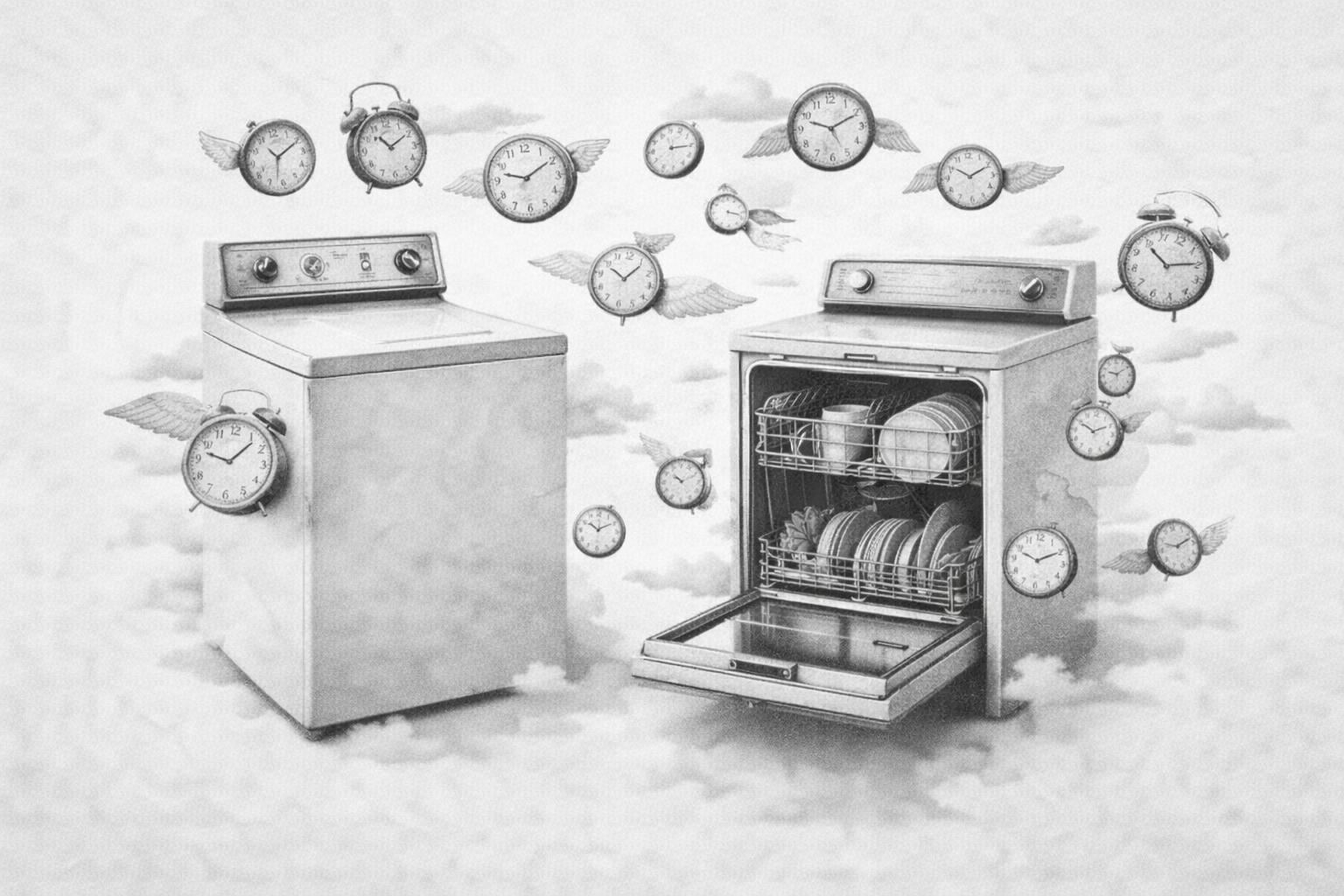
Three unrelated conversations inside a few days, with the head of a primary and secondary school, with a leadership workshop in Memphis, and with a reader, all landed on the same subject: the washing machine, the dishwasher, the garbage disposal. When those became common in mid-century American homes, hours of physical labor collapsed into minutes, and the time was supposed to go back to mothers and their children.
Economists have a name for what happened instead. The productivity paradox describes technologies designed to increase efficiency that do not deliver the gains we expect (Solow, 1987; Brynjolfsson, 1993). Expectations rise, norms shift, and what was a luxury becomes the new baseline. By the late 1950s roughly 3 out of 4 American households owned a washing machine, and those same decades brought the birth control pill, the Sexual Revolution, and a rapid expansion in college enrollment. Technology, medicine, and social change were all moving at once.
The smartphone is the clearest modern case. It removed the friction from communication, and boundaries went with it. You cannot leave the receiver off the hook anymore. Work follows you home and conversations follow you everywhere. Ryan notes that boundaries and authenticity became the anthem words of Gen Z precisely because the technology built to connect us dissolved the natural limits that used to exist.
Now AI removes friction at a scale we have not seen, and what it removes is experience itself. Experience is what forms character and wisdom. Ryan is not arguing technology is bad, and he credits medicine, communication, and transportation with alleviating real suffering. His argument is that progress always involves trade-offs, and that friction taught patience, limitation demanded creativity, and waiting made room for reflection.
The productivity paradox: technologies designed to increase efficiency do not always result in the productivity gains we expect (Solow, 1987; Brynjolfsson, 1993).
Mid-century appliances were supposed to hand time back. By the late 1950s roughly 3 out of 4 American households owned a washing machine, but expectations rose to meet the new capacity and the baseline simply moved.
Every time we remove friction, we increase dependency on a non-human experience. We replaced manual labor with machines, conversation with messages, memory with search engines, and now parts of thinking itself with AI.
Smartphones removed the friction from communication and took boundaries with it. That is why boundaries and authenticity became the anthem words of Gen Z.
The friction AI removes is experience, and experience is what forms character and wisdom. The goal of progress may not be eliminating every obstacle but deciding which friction is worth keeping.
Plain-language definitions for the ideas in this episode. Structured for search and AI answers.
The phenomenon where technologies designed to increase efficiency do not produce the productivity gains expected of them (Solow, 1987; Brynjolfsson, 1993).
In this episode: Why the appliances that saved hours did not hand anyone their afternoon back.
Ryan Vet's term for the widening distance between how fast technology advances and how fast we understand the moral and human implications of it.
In this episode: The frame connecting mid-century appliances to generative AI.
The practice of deciding which obstacles are worth preserving for what they form in people, rather than removing every obstacle by default.
In this episode: Ryan's closing argument about what progress should actually optimize for.
Lines worth keeping, verbatim from the episode.
Every time we remove friction from our lives, we tend to increase our dependency on a non-human experience.
Maybe the goal is deciding which friction is worth keeping.
Experience is what fosters character and forms wisdom.
Straight answers to the questions this essay raises. Open by default, structured for search and AI.
What is the Velocity Gap? +
The Velocity Gap is the growing distance between how fast technology advances and how slowly we understand its impact on the human experience. Ryan Vet argues we have accelerated in technological advancement faster than in understanding the moral implications of those advancements. The unintended consequences do not reveal themselves as quickly as the technology arrives, and that distance keeps widening.
What is the productivity paradox? +
The productivity paradox describes the phenomenon where technologies designed to increase efficiency do not always result in the productivity gains we expect. In other words, the tools that promise to save us time do not necessarily give us more of it. The essay points to mid-century household appliances, which automated hours of labor but did not hand anyone back the free time they seemed to promise.
How does the smartphone illustrate the essay's argument? +
Smartphones were designed to remove friction from communication so people could connect instantly. But when communication friction disappeared, boundaries disappeared with it. Work follows you home, conversations follow you everywhere, and the line between work and life begins to blur. Ryan Vet notes this is part of why boundaries became such an anthem for Generation Z.
Why does removing friction concern Ryan Vet when it comes to AI? +
The essay argues that every time we remove friction, we tend to increase our dependency on a non-human experience. Machines replace manual labor, messages replace conversations, and search engines replace memory, and with artificial intelligence we begin to replace parts of thinking itself. The worry is that friction is essential to the human experience, because experience is what fosters character and forms wisdom.
What does the essay conclude about progress? +
Ryan Vet does not argue that technology is bad, noting that progress has improved human life in extraordinary ways through medicine, communication, and transportation. Instead, he suggests the goal of progress may not be to eliminate every obstacle, but to decide which friction is worth keeping. Friction taught patience, demanded creativity, and created space for reflection, so some of it is worth preserving.
Full show notes
What do washing machines, smartphones, and artificial intelligence have in common?
They were all designed to make life easier. But they may have also changed the human experience in ways we didn’t anticipate.
In this episode, Ryan Vet explores the concept of the Velocity Gap, the growing distance between how fast technology advances and how slowly we understand its impact on our lives.
From household appliances in the mid-20th century to smartphones and the rapid rise of AI, this conversation connects technology, generational behavior, leadership, and culture in ways many overlook.
You’ll discover:
Why time-saving technology doesn’t actually give us more time (the productivity paradox)How Baby Boomers, Gen X, Millennials, and Gen Z were shaped by different levels of frictionWhy modern life feels more connected—but also more isolatingThe hidden trade-offs of removing friction from communication, work, and thinkingWhat artificial intelligence means for the future of human experienceHow leaders can intentionally choose which friction to remove—and which to preserveThis episode challenges a core assumption of modern life:
👉 Progress isn’t just about making things easier. It’s about deciding what’s worth keeping.
Send us Fan Mail
About Ryan VetRyan Vet is a USA TODAY bestselling author, futurist, and international keynote speaker whose insights on generations, culture, and the future of work have been featured in Forbes, Financial Times, ABC, NBC, and CBS. His research helps leaders understand emerging generational patterns and anticipate societal shifts before they fully unfold.
Join 20,000+ Leaders for Weekly InsightsIf you want deeper research and behind-the-scenes insights on generations and the future of culture and society, join Ryan’s weekly newsletter: 👉 https://ryanvet.com/collide