Gen Z Is Ungrounded and Going Back to the Mall
Positive trends are emerging, pointing to Gen Z's desire to be back in-person and in real life (IRL).
Read the full essayThe data behind this essay. Every figure traces to a source the essay cites. Hover any card to share it.
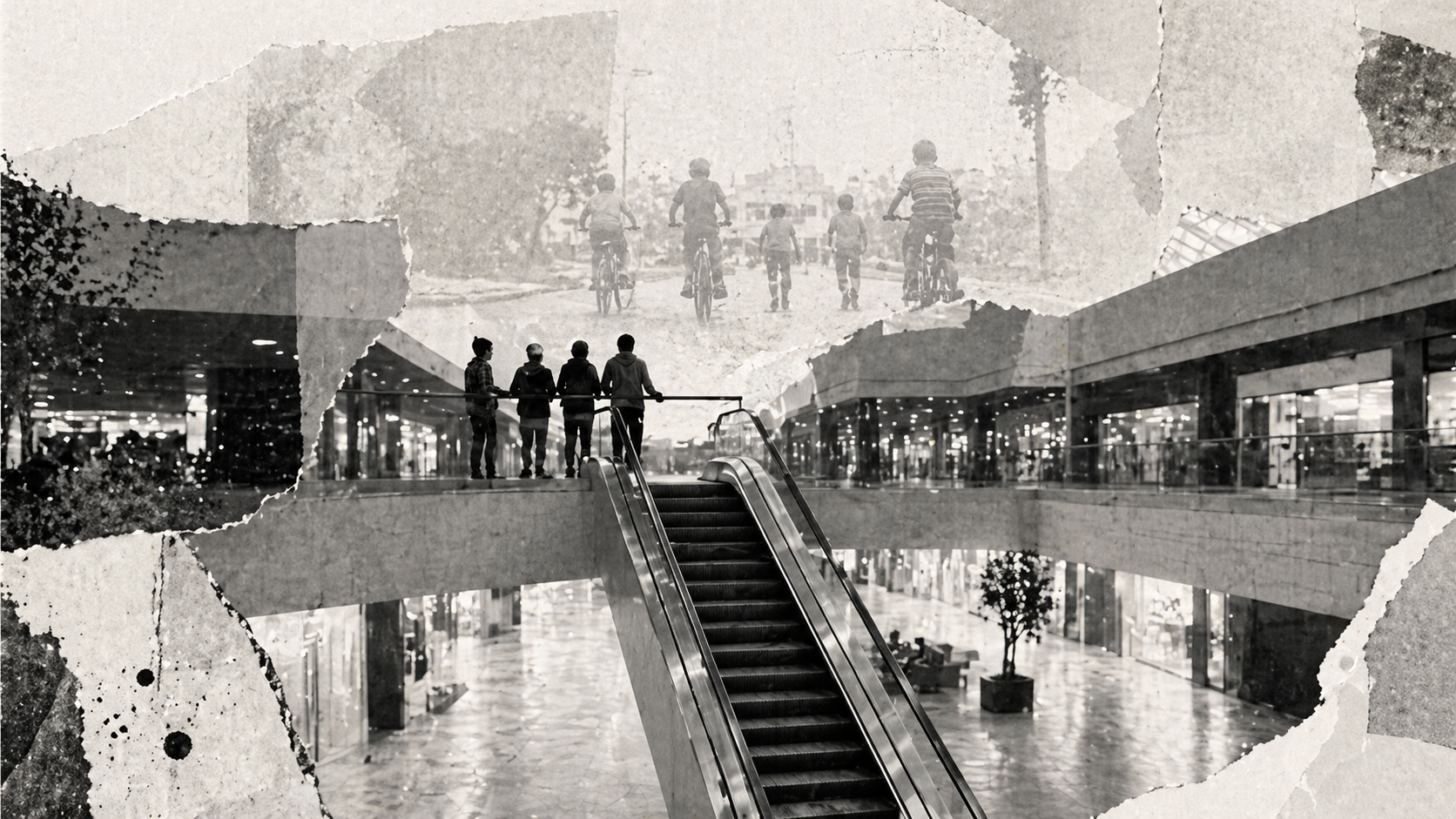
The mall was never really about shopping. It was about getting just enough freedom to become a more well-rounded person.
Ryan opens in Charlestowne Mall: Waldenbooks, FYE, KB Toys, Auntie Anne's, and the strictly forbidden Spencer's and Hot Topic. What mattered was not the stores but the ordinary trust attached to them, like a dad dropping middle schoolers at the movies with a time and place to meet and then simply leaving.
The physical world is coming back. Lightspeed research found 83 percent of 18 to 24 year olds say social retail environments improve their sense of connection, 68 percent would spend more as a result, and 75 percent say third spaces matter when choosing where to shop (Lightspeed, 2026). Placer.ai found consistent year-over-year visit growth at indoor and open-air centers, with 37.6 percent of indoor mall visits in 2025 lasting more than 75 minutes (Placer.ai, 2026). Starbucks is uplifting more than 1,000 coffeehouses by the end of 2026 to make them places to linger again.
The contrast Ryan draws is between two skeptical generations. Gen X was rarely watched, Gen Z has been over-watched. Gen X came home to empty houses, Gen Z had their movements tracked inside their own. Gen X learned social rules by bumping into them, Gen Z learned social risks by watching them get recorded, posted, mocked, and stored forever. Gen X said I do not trust you so I will take care of myself. Gen Z says I do not trust you, but I also do not know where else to go.
The leadership takeaway is blunt and Ryan says so. If you rob a generation of certain childhood experiences, they arrive at work less prepared. If a young employee did not get unstructured social reps, do not be shocked when they struggle in unstructured social environments. The fix is not forced fun or another trust fall. It is real apprenticeship, multi-age interaction, lunches without an agenda, and leaders willing to explain not just what they decided but how.
83 percent of 18 to 24 year olds say social retail environments improve their sense of connection, and 75 percent say third spaces matter when deciding where to shop (Lightspeed, 2026).
37.6 percent of indoor mall visits in 2025 lasted more than 75 minutes, with indoor malls functioning increasingly as experiential third places (Placer.ai, 2026).
Gen X was rarely watched and Gen Z has been over-watched. That is not a small difference, it is a formative one.
The share of Americans saying most people can be trusted fell from 46 percent in 1972 to 34 percent in 2018, and Pew's 2023 to 2024 polling found the same 34 percent (Pew Research Center, 2025).
If you rob a generation of certain childhood experiences, they come to the workplace less prepared. Maturity comes from practice, and no amount of online content substitutes for lived experience.
Plain-language definitions for the ideas in this episode. Structured for search and AI answers.
A gathering space that is neither home nor work, where people linger without a transaction as the point. Cafes, lounges, bookstores, and mall common areas all qualify, and Gen Z now weighs their presence when choosing where to shop.
In this episode: The retail data showing physical space regaining value precisely because it is inefficient.
Ryan Vet's model of generational change, in which trends can skip a generation or two and resurface in a new form. Here it shows up as a reflection between Gen X and Gen Z.
In this episode: The frame for why the most digital generation is reaching for the physical world.
Low-stakes, unsupervised practice at being around other people: making plans, budgeting finite cash, being late, watching someone else make a bad decision. Ryan argues these are what form workplace maturity.
In this episode: What the mall actually provided, and what a Slack onboarding checklist cannot.
Lines worth keeping, verbatim from the episode.
if you rob a generation of certain childhood experiences, they're going to come to the workplace less prepared
Constraints form people.
Gen X was rarely watched. Gen Z has been over-watched.
Straight answers to the questions this essay raises. Open by default, structured for search and AI.
What is the Generational Pendulum? +
The Generational Pendulum is one of Ryan Vet's core frameworks. It describes how a generation experiences something, often challenges it, then overcorrects and rebels, and eventually recalibrates to a new normal. In this essay, Gen Z's return to malls and other in-person spaces is presented as the pendulum swinging back toward physical community after years of digital-first life.
Why is Gen Z, the most digital generation, going back to malls and bookstores? +
Gen Z is not simply buying in person, they are gathering in person. Lightspeed research cited in the essay found that 83% of 18-to-24-year-olds say social retail environments improve their sense of connection. The essay ties this to an earlier look at Barnes & Noble and the return of physical bookstores as part of the same in-real-life comeback.
How was Gen Z's childhood different from Gen X's? +
Gen X was rarely watched and Gen Z has been over-watched. Gen X came home to empty houses and disappeared into malls, while Gen Z had their movements tracked and were location-shared into structured activities. Ryan Vet argues this difference is formative, not cosmetic, because it shaped how each generation learned social rules.
What does Ryan Vet mean when he says the mall was practice? +
The essay argues the mall was never really about shopping, it was about practice. With a finite amount of cash and a few hours of freedom, kids practiced budgeting, trade-offs, self-control, making plans, and watching peers make bad decisions in real time. A generation that skipped that practice arrives at adulthood and work without those reps.
What is the leadership takeaway for the workplace? +
If you rob a generation of certain childhood experiences, they will come to the workplace less prepared. The essay argues leaders cannot expect a Slack onboarding checklist to replace lived experience, so workplaces need more unstructured time, mentorship, multi-age interaction, and real apprenticeship. This connects to patterns like the Gen Z stare and other so-called awkwardness at work.
Full show notes
The most digital generation is going back to the mall. Generational futurist Ryan Vet explains why Gen Z’s IRL revival is a leadership signal.
Ryan Vet, generational futurist, expert in generations, and AI keynote speaker, unpacks the resurgence of physical retail, the Generational Pendulum, and what Gen Z’s return to malls, bookstores, and coffee shops reveals about how this generation was formed. A generation that was tracked, supervised, and over-scheduled is now hunting for the unstructured, in-person moments older generations took for granted. The workplace is next.
Key Takeaways
Gen Z’s foot traffic at malls is up 57% year-over-year, and 82.2% of Gen Z mall-goers say they are there to socialize, not to shop (Placer.ai, 2026).The Generational Pendulum is swinging back: 83% of 18-to-24-year-olds say social retail environments improve their sense of connection (Lightspeed, 2026).Gen X was rarely watched. Gen Z has been over-watched. That difference is formative, not cosmetic.The mall was practice. It taught budgeting, trade-offs, self-control, and watching peers make bad decisions in real time. A generation that skipped that practice arrives at work without those reps.Gallup (2025) reports Gen Z is the loneliest generation at work, nearly twice as likely as Gen X to say they experienced loneliness a lot of the previous day.Leaders cannot replace lived experience with a Slack onboarding checklist. Workplaces need more unstructured time, multi-age interaction, and real apprenticeship.The recalibration has already started. Gen Alpha (currently 1-13) may be the generation whose parents intentionally design a more analog childhood.Research and Sources Cited
Lightspeed. (2026). Gen Z wants more than products: 83% of 18-24-year-olds say hangout stores boost connection.Placer.ai. (2026). How malls can win in 2026.Pew Research Center. (2014). Generation X: America’s neglected middle child.Pew Research Center. (2025). Americans’ trust in one another.Gallup. (2023). Gen Z voices lackluster trust in major U.S. institutions.Gallup. (2025). State of the global workplace: 2025 report.Starbucks. (2025). Starbucks coffeehouse designs enter a new era.City of St. Charles, Illinois. (n.d.). Charlestowne Mall redevelopment.Business Insider. (2025). Starbucks plans to phase out its mobile-only stores for a future with more warmth and human connection.Connect with Ryan Vet
Read the full essay: Gen Z Is Ungrounded and Going Back to the MallSubscribe to Collide: www.RyanVet.com/collideWebsite: www.RyanVet.comLinkedIn: linkedin.com/in/ryanvetYouTube: @RyanVetBook Ryan to speak: ryanvet.com/bookingAbout Ryan Vet Ryan Vet is a generational futurist, USA TODAY bestselling author, international keynote speaker, and host of The Ryan Vet Show. As an expert in generations and an AI keynote speaker, he helps leaders, parents, and organizations make sense of how Boomers, Gen X, Millennials, Gen Z, Gen Alpha, and Gen Beta are reshaping work, family, and culture. Collide is his weekly research-backed newsletter on generational leadership, read by 21,000+ leaders.
#GenerationalFuturist #GenZ #GenX #GenAlpha #Loneliness #ThirdPlaces #Mentorship #Leadership #ExpertInGenerations #RyanVet #CollidePodcast #AIKeynoteSpeaker #FutureOfWork
Send us Fan Mail
About Ryan VetRyan Vet is a USA TODAY bestselling author, futurist, and international keynote speaker whose insights on generations, culture, and the future of work have been featured in Forbes, Financial Times, ABC, NBC, and CBS. His research helps leaders understand emerging generational patterns and anticipate societal shifts before they fully unfold.
Join 20,000+ Leaders for Weekly InsightsIf you want deeper research and behind-the-scenes insights on generations and the future of culture and society, join Ryan’s weekly newsletter: 👉 https://ryanvet.com/collide