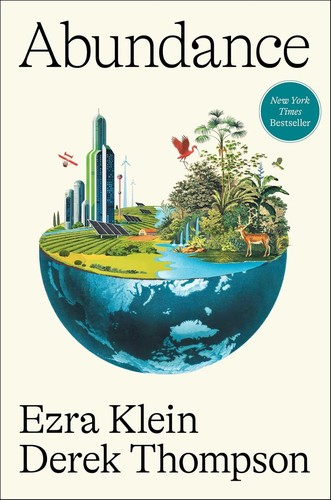
Abundance
Abundance by Ezra Klein and Derek Thompson (2025) — Ezra Klein and Derek Thompson argue that American scarcity is self-inflicted, produced by rules and risk aversion rather than by any real limit on resources.
Reviewed by Ryan Vet · Last updated
What is Abundance about?
Ezra Klein and Derek Thompson argue that the United States has developed a governing style that blocks the building of homes, infrastructure, clean energy, and public goods, even where the political will exists. They propose an 'abundance agenda' focused on removing procedural and regulatory bottlenecks so that liberal and progressive goals can actually be delivered at scale.
Is Abundance worth reading?
Worth reading for the systems argument even if you disagree with the politics, and plenty of readers will. The strongest chapters are the ones about how breakthroughs actually happen, which is messily and non-linearly. The weakest move is the claim that innovation has broadly stalled, which overstates a real trend.
Read it if…
- You think about why good ideas fail to become real things
- You want a systems lens rather than a policy fight
- You work in or near innovation and keep hitting process walls
Skip it if…
- You want a neutral read, because the politics are present
- You already accept that permitting and risk aversion are the bottleneck
- You want evidence rather than argument
Ryan's take
The Edison chapter is the best explanatory frame in the book. He did not invent the bulb. He invented the delivery system: the switches, the generators, the meter that let you bill for it. That is how a generation forms too, not one thing but many strung together. Where I part ways is the innovation-has-stalled framing. Biotech and AI are real. The broader point still holds.
Where Ryan has discussed this book
 The affordability math from the 1970s, 80s, and 90s is broken. Mike Schneider of Acre Homes: The Generational Housing Question, the Broken Affordability Math, and Shared Ownership
 Frequently asked questions about Abundance
What did Edison actually invent?
Not the bulb. Someone else had the incandescent glass, someone else the battery. What Edison built was everything around it: switches you could turn on and off, generators delivering steady power, wiring, and a meter so the energy could be billed. He thought about the whole system. That is the part people forget and the part that mattered.
What does Edison have to do with generations?
This is my extension rather than theirs. We say Millennial the way we say the lightbulb, as though it were one thing. It is not. It is many components strung together, layered over years, until the assembled result gets a single name. The iPhone works the same way. It invented almost none of its parts and systematized all of them.
What is the lizard spit story?
Research on a lizard whose saliva lets it go months without eating became a diabetes treatment and eventually the GLP-1 weight-loss drugs. Nobody funded that expecting Ozempic. It is the cleanest illustration I know that the biggest breakthroughs come from work that looked pointless, and that we are steadily defunding exactly that kind of work in the name of reducing risk.
Do you agree that innovation has stalled?
Not fully. Their framing is that someone asleep from 1835 to 1905 wakes to skyscrapers, cars, film, and the hamburger, while someone asleep from 1995 to 2025 wakes to faster computers. It is a powerful comparison and it is not universally true, because biotech and AI are real. The general point, that visible life-changing innovation has slowed, is still defensible.
Why do industries cluster in one city?
Film in Hollywood, finance in New York, software in the Valley, because the people who want to make it have to move there. Concentration of talent produces innovation, with real downsides. I watch this happening around me with biotech in Raleigh-Durham. It is also how generations form, since shared geography produces shared formative experience.
Books like Abundance
Publication details
- Publisher
- Avid Reader Press
- Published
- 2025
- Pages
- 304
- ISBN-13
- 9781668023488